
One of the challenges I often encounter with my clients is the gap between the language of finance and accounting and the language of ordinary people.
There is, indeed, a world of difference between the two.
When an ordinary person sells something and receives money, the immediate concern is simple: “Money has come in.”
He or she is not necessarily thinking about the transaction in accounting terms or asking which account should be debited or credited.
An accountant, however, sees the same transaction differently. The receipt of money has to be recorded appropriately, while the source of the money must also be identified and reflected in the corresponding accounting records.
This difference in language can create considerable confusion for people who handle money but have no formal accounting training.
It therefore raises an important question: Why should everyone who handles money be expected to think like an accountant?
Let People Describe What Happened
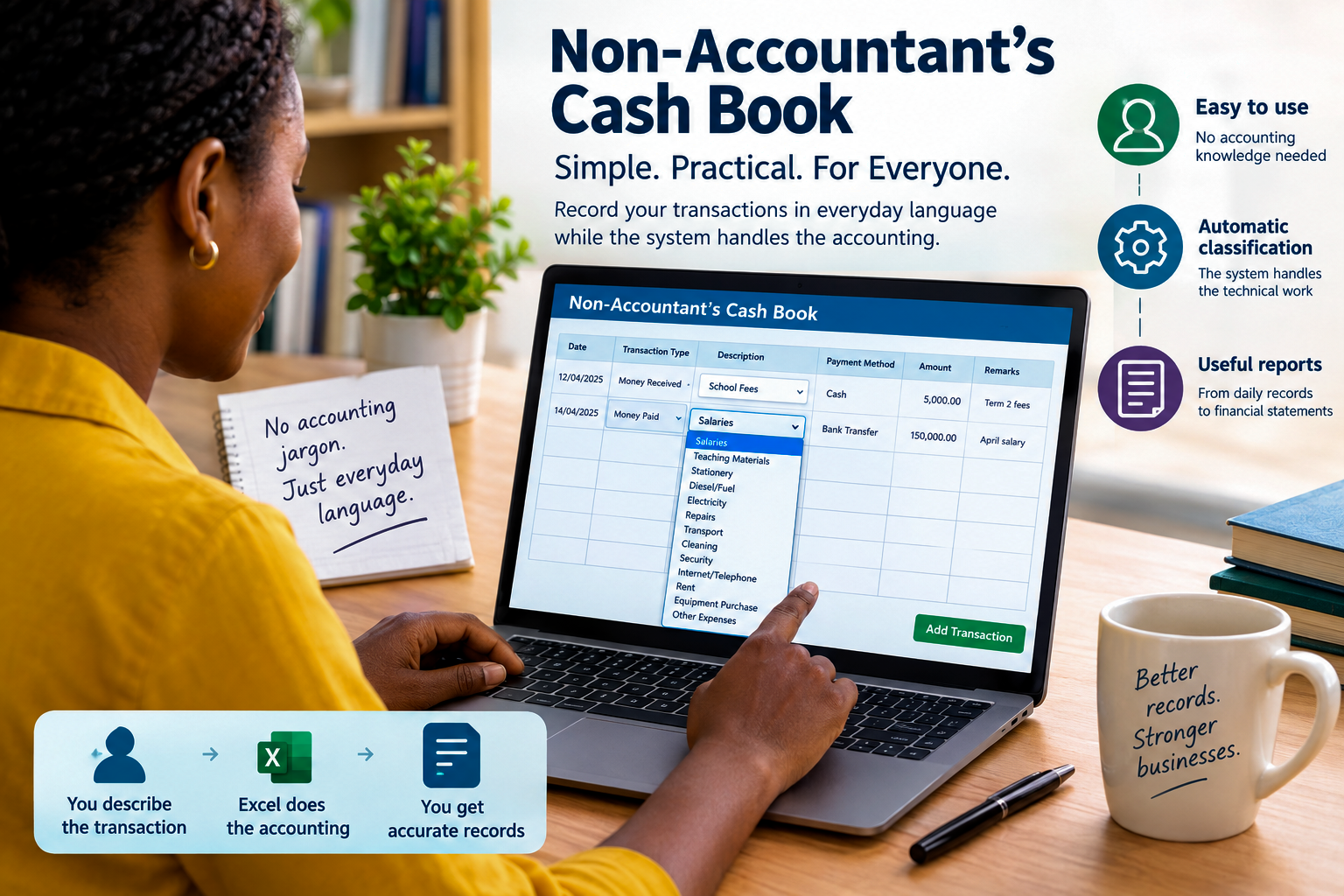
My proposed solution is what I call the Non-Accountant’s Cash Book—an Excel-based system designed to allow ordinary people to record financial transactions using everyday language.
The idea is straightforward: you should not have to understand debits and credits before you can accurately record what happened.
Instead, the system asks a simple question:
What did we receive or pay money for?
For a school, for example, the options could include:
- School fees received
- Registration fees received
- Uniforms sold
- Books sold
- Transport fees received
- Salaries paid
- Teaching materials purchased
- Stationery purchased
- Diesel or fuel bought
- Electricity paid
- Repairs carried out
- Security services paid
- Internet or telephone expenses
- Rent paid
- Equipment purchased
The user simply selects the description that best explains the transaction.
The Excel system then handles the more technical work of translating that everyday description into the appropriate accounting classification.
Changing the Language of Financial Records
The major change is therefore not necessarily in the accounting principles themselves, but in the language used to capture financial transactions.
Instead of asking a school administrator, cashier or employee to determine whether a transaction should be treated as a debit, credit, revenue, expenditure, asset, liability or ledger account, the system presents descriptions that the user can understand.
For example, under Money Received, the system could provide options such as:
- School fees
- Registration fees
- Uniform sales
- Book sales
- Transport fees
- Feeding fees
- Donations
- Other income
Under Money Paid, it could provide:
- Salaries
- Teaching materials
- Stationery
- Diesel/fuel
- Electricity
- Repairs
- Transport
- Cleaning
- Security
- Internet/telephone
- Bank charges
- Rent
- Equipment purchases
- Other expenses
The objective is simple:
Describe the transaction. Let the system handle the accounting.
A Three-Level System
The Non-Accountant’s Cash Book is being developed around three levels.
Level 1: Data Entry
This is the part of the system that the ordinary user or employee interacts with.
It should be deliberately simple, with features such as:
- Drop-down menus
- Clear transaction descriptions
- Protected formulas
- Simple instructions
- Money-in and money-out columns
- Transaction dates
- Payment methods
- Receipt or voucher numbers
- Remarks
The person entering the transaction should not need to understand accounting principles to use the system correctly.
This is the Level 1 draft I am currently presenting.
Level 2: Accounting Classification
Behind the data-entry sheet, Excel automatically translates the everyday description into the appropriate accounting classification.
For instance, selecting “School Fees” can automatically feed the transaction into the appropriate income account, while selecting “Diesel/Fuel” can feed it into the relevant expense account.
The information can then feed into the organisation’s chart of accounts without requiring the person entering the transaction to understand the technical accounting structure.
Levels 2 and 3 are currently being developed.
Level 3: Accountant’s Reports
At this stage, information entered by ordinary users can be transformed into reports that business owners, managers or accountants can use for more detailed financial management.
These may include:
- Detailed cashbooks
- Bank reconciliation
- Trial balances
- Income and expenditure reports
- Debtors analysis
- Management reports
- Financial statements
The underlying idea is that the person entering a transaction does not have to become an accountant before an organisation can maintain useful financial records.
What If You Don’t Know What to Select?
There is another practical problem that needs to be addressed.
What happens when an employee encounters a transaction and does not know which option to select?
The answer is simple:
Don’t guess.
I propose including a “NEED HELP” option in the transaction-type list.
If a worker is unsure how to classify a transaction, he or she simply selects “NEED HELP”. The transaction can then be reviewed periodically by the owner, administrator or accountant and classified appropriately.
This is preferable to forcing someone to make an incorrect classification simply because the system requires an answer.
A Different Philosophy of Bookkeeping
The Non-Accountant’s Cash Book is based on a fundamental shift in how we approach financial record-keeping.
The traditional approach often seems to be:
“Teach everybody bookkeeping before they can enter financial transactions.”
My proposed approach is different:
“Let people describe what happened, while the accounting system does the bookkeeping.”
For business owners, school administrators and other people who handle financial transactions without formal accounting training, this approach could make financial record-keeping considerably easier and potentially reduce posting errors.
But this is not an attempt to eliminate accountants.
Far from it.
The objective is to make accountants more effective by allowing ordinary employees to capture financial events correctly in language they understand, while the accounting system handles the technical translation.
It creates a bridge between two worlds.
The employee speaks the language of everyday transactions.
The system speaks the language of accounting.
And the accountant gets cleaner information with which to do the work that requires professional judgment.
That, ultimately, is the philosophy behind the Non-Accountant’s Cash Book.
The Level 1 draft is the beginning of the concept. Levels 2 and 3 are currently being developed to demonstrate how everyday transaction entries can eventually feed into more sophisticated accounting and management reports.
If successful, the system could provide a simpler way for non-accountants to participate in proper financial record-keeping without requiring them to become accountants first.
James Olu Gbolagoke of Gbola Empower Consult is an accountant, entrepreneur and financial consultants